
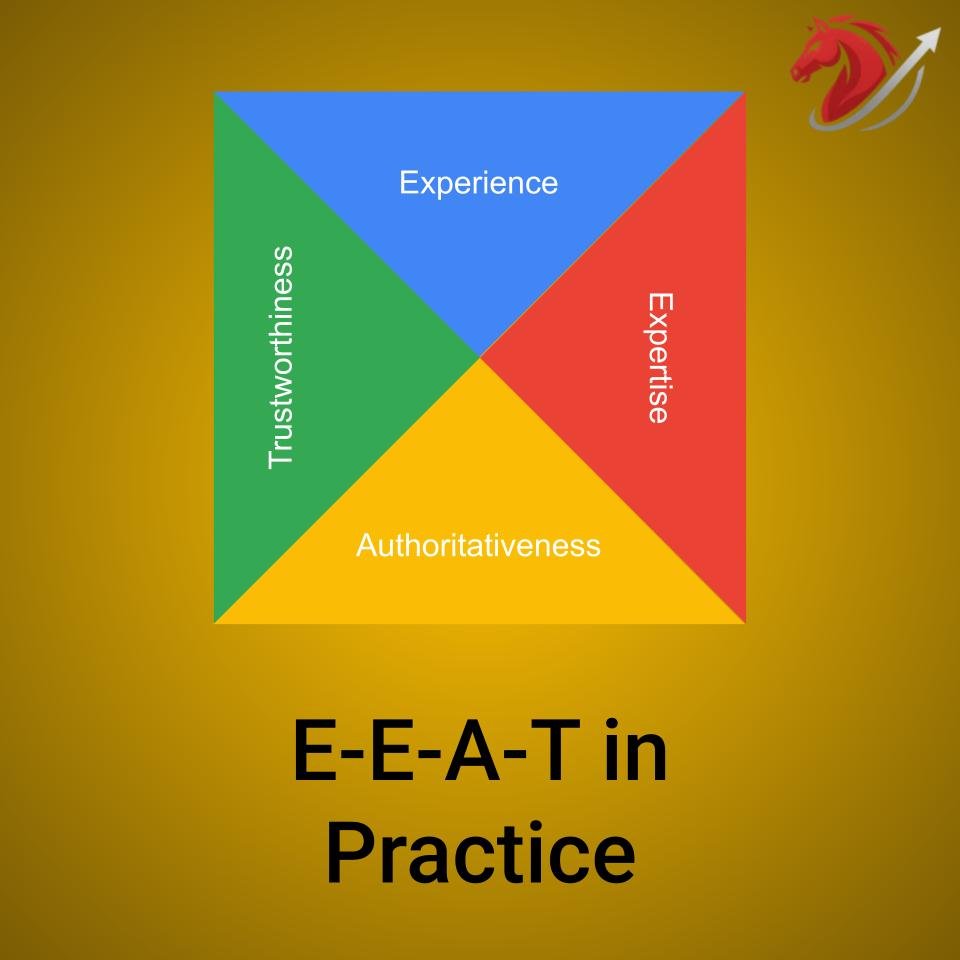
E-E-A-T is Google’s four-part framework — Experience, Expertise, Authoritativeness, and Trustworthiness — for evaluating whether content is genuinely helpful, credible, and made for real people. It is not a single ranking switch, but the signals that reflect it directly shape how Google’s systems evaluate your pages — and in 2026, after back-to-back Core Updates in December 2025 and March 2026, it has never mattered more.
If you’re producing content in health, finance, legal, or any YMYL space — or working with an Organic Search Engine Optimization Company to improve visibility — understanding and implementing E-E-A-T is foundational, not optional.
Where E-E-A-T Came From
Google has used Search Quality Rater Guidelines (SQRG) — a public document used by human evaluators to assess whether search results are helpful and relevant — as its quality benchmark for years. The full guidelines are publicly available on Google’s website.
The original framework was E-A-T (Expertise, Authoritativeness, Trustworthiness), designed to assess content beyond just keywords and backlinks.
In December 2022, Google added a second “E” for Experience — formally recognizing that first-hand knowledge (personally using a product, visiting a place, going through a process) adds real value that well-researched-but-secondhand content cannot replicate.
Key milestones in E-E-A-T’s evolution:
- 2014 — E-A-T first introduced in Google’s SQRG
- 2018 — Medic Update made E-A-T a mainstream SEO priority for YMYL content
- December 2022 — “Experience” added, framework becomes E-E-A-T
- 2023–2024 — Helpful Content System merged into core algorithm; original content rewarded
- December 2025 Core Update — Google further devalued mass-produced, experience-absent content across all niches
- March 2026 Core Update — Transparency signals (author disclosure, editorial policy, AI-use declaration) became stronger quality indicators💡 Quick note on YMYL: E-E-A-T carries the highest weight for health, finance, legal, and safety content — where inaccurate information can cause real harm. But since 2024, Google has applied its quality criteria more broadly across all competitive niches.
Why E-E-A-T Matters in 2026
E-E-A-T aligns your content with what Google’s systems are built to reward: helpful, reliable information made for real people, not content built to manipulate rankings.
Google is explicit that E-E-A-T is not a direct ranking factor, but as stated in Google’s own Search Central documentation, “our systems are designed to reward content that demonstrates these qualities.” The signals that reflect E-E-A-T — author credentials, sourcing, trust elements, original evidence — do influence how pages are evaluated.
Think of it this way: E-E-A-T is the credibility layer. Basic SEO (crawlability, indexing, internal links, page speed) is the delivery system. One doesn’t replace the other — you need both working together.
According to Google’s advice for content creators: “SEO can be a helpful activity when applied to people-first content.”
The 4 Components of E-E-A-T:
1. Experience (First “E”)
Experience means you’ve actually done the thing — used the product, run the test, visited the place, or lived through the process. It is first-hand knowledge, not just research pulled from other sources. This is the pattern we see most often when a new client comes to us with declining traffic.
Google added Experience in 2022 precisely because well-written secondhand summaries were flooding search results. First-hand involvement is something AI and content farms cannot authentically replicate — making it your most durable competitive advantage in 2026.
What counts as Experience:
- Product use — You’ve personally used or tested what you’re writing about, not just summarized specs from a manufacturer’s page
- Process walkthroughs — You’ve gone through the steps yourself and can describe what actually happened, including what went wrong
- On-site visits — For travel, local businesses, or venue reviews, you’ve physically been there
- Time-based observations — Documented changes over days or weeks: a diary, log, or before-and-after comparison
- Original photos, screenshots, or recordings — Visual proof that you were there or did the thing
- Personal outcomes — Real results or numbers from your own experience, not generic claims
Here’s what we saw with one of our clients:
We worked with a Medical Tourism company based in Los Angeles (name withheld for confidentiality). The website was well-structured and had a solid off-page SEO strategy in place — but the content lacked one critical element: the brand’s own real-world experience.
The pages listed treatments, destinations, and procedures, but none of the content reflected what the company had actually seen, facilitated, or learned from working with real patients. There were no first-hand observations, no process insights, and no genuine perspective from the team behind the brand.
Over time, organic traffic declined steadily. The team doubled down on link building and off-page efforts, but the drop continued — because the problem was in the content itself.
Once we identified the gap, we worked on incorporating their actual experiences: patient journey insights, process-level details, and observations from facilitating real cases. The content shifted from generic information to something only this company could have written.
2. Expertise (Second “E”)
Expertise is demonstrated knowledge — accurate, well-sourced information presented in a way that builds trust, ideally tied to a clearly identified author or site.
Expertise doesn’t always require a formal degree. A mechanic writing about car repair, a nurse writing about patient care, or an experienced investor writing about portfolio strategy — all represent legitimate expertise when the content is accurate and the author is identified.
Topical depth is non-negotiable. A website that only partially covers a topic signals shallow expertise — and both users and search engines notice. To be seen as a genuine authority, your content needs to address the subject thoroughly.
How to implement it:
- In-depth guides and thorough topic pages don’t just help users — they signal to search engines that your site is a complete resource, not a surface-level one.
- Cover related questions, subtopics, and use cases that a real expert would naturally speak to.
- Add clear bylines and author pages (the “Who”), including credentials and professional background where relevant
- Cite primary sources for verifiable claims — link to studies, official documentation, or original reports
- Avoid vague advice — show your decision-making process and methodology so guidance is clear and repeatable
- Have subject-matter experts review content in sensitive niches (health, law, finance) and credit them visibly
At Rank Stallion, topical depth isn’t just advice we give — it’s a standard we hold ourselves to. We cover every subject comprehensively, knowing that consistent quality compounds into authority.
3. Authoritativeness (A)
Authoritativeness is reputation — recognition that your site, brand, or author is a known, trusted source in a specific topic area. It is what someone would find if they independently researched your site and asked: “Is this widely recognized as an authority on this subject?”
Authoritativeness is closely tied to topical authority — the idea that covering a subject comprehensively and consistently signals to Google that your site is the go-to resource for that domain. A site with a tightly focused content cluster covering every relevant angle of a topic builds far stronger topical authority than one publishing broad, scattered content. Based on our recent client work, case studies, and observed Google behaviour, one thing is increasingly clear — topical authority is becoming a stronger ranking signal, not a weaker one.
How to implement it:
- Earn citations and mentions by publishing things others need to reference: original data, tools, benchmarks, unique processes, or frameworks
- Build your author’s off-site reputation: conference talks, guest articles, podcast appearances, and industry interviews all contribute to authoritativeness signals
- Build pillar pages and topic clusters — Create one comprehensive pillar page on your core topic, then build supporting cluster articles around every subtopic and related question within it. Link them all together with a clear internal linking structure. This tells Google that your site covers the subject from every angle, not just the surface. (Topical Authority)
- Cover the full depth of your topic, not just the obvious keywords — Use keyword and content gap research to find every question, subtopic, and angle your audience searches for — including ones your competitors have missed. The goal is to become the one site that a user (or Google) never needs to leave when researching your subject. (Topical Authority)
One simple outreach strategy that grew a client’s organic traffic within weeks:
One of our clients runs a community organization that brings together craft enthusiasts in North Georgia, US. The site had solid content but was missing one key off-page signal: relevant backlinks. We reached out to his vendors, suppliers, and partner organizations and asked them to link back to his site. Within weeks of implementing this, his organic traffic began climbing — a clear reminder that for community and niche sites, your existing relationships are often your best link-building opportunity.
4. Trust (T) – The Most Important Pillar
Trust is the deciding layer. Google explicitly states in its Search Quality Rater Guidelines that Trust is the most important component of E-E-A-T. If users cannot trust your page — or if Google’s systems cannot verify your page is honest and safe — nothing else about your content matters.
How to implement it:
- Make trust visible across the full page: About page, contact details, editorial policy, privacy and refund policies, clear affiliate or advertising disclosures, accurate publication and update dates, and correction notes
- Disclose AI use where users would reasonably expect it — Google’s 2025 guidance specifically calls this out as a transparency signal
- Focus on the full page experience — trust is not one checkbox, it is the cumulative signal from every element on the page
We believe trust starts with transparency. That’s why we openly share our team’s certifications and real client experiences — so you can make an informed decision before working with us.
What Changed in the AI Era (2024–2026)
The rise of AI-generated content at scale changed what Google must work harder to detect and reward. Key shifts:
- Experience became the clearest differentiator — first-hand involvement is what AI content cannot authentically simulate
- Helpful content doesn’t have to be long — it can come in many formats (videos, tools, data tables) as long as it is genuinely useful and evidence-backed
- Transparency became a stronger signal — Google recommends being clear about who wrote the content, how it was made, and why, including disclosing AI involvement where users would reasonably expect it
- The originality bar rose significantly — rewriting existing content without adding something meaningfully new is now a clear quality warning sign in Google’s guidelines, reinforced in both the December 2025 and March 2026 Core Updates
What’s Gaining vs. Losing Value in 2026
| Gaining Importance | Losing Value |
|---|---|
| Original research, data, reporting | Mass-produced pages built mainly to capture traffic |
| Clear author bylines and credentials | Rewriting existing content without new insight |
| First-hand evidence: screenshots, real results | Chasing word counts or keyword density |
| Transparency about content creation process | “Search-engine-first” patterns Google now flags |
| Multi-format content (video, tools, visuals) | Anonymous, unattributed content on YMYL topics |
Frequently Asked Questions
Is E-E-A-T a direct ranking factor?
No. Google has confirmed E-E-A-T is not a direct ranking signal — there is no single “E-E-A-T score” that goes up or down based on what you publish. However, the elements that reflect it — author credentials, sourcing, trust signals, original evidence, and first-hand experience — do influence how Google’s systems evaluate your pages. Think of it as a quality standard rather than a metric. Google’s systems are designed to reward content that demonstrates these qualities, and the sites that consistently align with them perform more stably through Core Updates than those chasing short-term ranking tactics.
Does E-E-A-T matter for non-YMYL topics?
Yes. While E-E-A-T carries the highest weight for health, finance, legal, and safety content — where inaccurate information can cause real harm — Google’s 2024 and 2025 updates extended quality evaluation across all competitive niches. If you operate in travel, home improvement, technology, e-commerce, or any space where users make decisions based on your content, E-E-A-T is relevant. The practical threshold is simple: if trust and accuracy matter to the person searching, E-E-A-T matters for the page answering them. In 2026, that covers almost every competitive niche.
How do I demonstrate Experience as a brand (not an individual)?
Brand-level experience is built by documenting what your organisation has actually done — not just what it offers. Publish case studies with real process details and measurable outcomes, create “how we built this” or “how we approach this” sections that reflect your methodology, share behind-the-scenes data, original observations from client work, and team photos from real projects. The key is specificity — generic claims of experience carry no weight, but a detailed account of what your team observed, decided, and delivered is something no competitor can replicate. Brand experience signals work when they are verifiable, specific, and accompanied by visible evidence.
Should I disclose when AI helped write the content?
Yes, when users would reasonably want to know — and for most informational or YMYL content, they would. Google’s guidance specifically calls out transparency about content creation as a trust signal, and disclosing AI involvement paired with clear editorial oversight builds credibility rather than undermining it. A straightforward note — such as stating that content was drafted with AI assistance and reviewed by a named, qualified team member — is enough. What damages trust is not the use of AI itself, but publishing AI-generated content that is generic, unverified, or unattributed to any responsible human. Disclosure handled well is a trust asset, not a liability.
How do I write an author bio page that satisfies E-E-A-T? What should it include?
An author bio page should answer three things clearly: who the person is, what qualifies them to write on this subject, and where their work can be verified. Include the author’s name, professional background, relevant certifications or credentials, areas of expertise, and links to other published work or professional profiles. For YMYL topics, add a brief note on how the author’s experience directly informs the content they produce. Keep it specific — “10 years in healthcare SEO” is more credible than “experienced professional.”
How do I add Experience signals to older content that’s already published?
Start by identifying which pages cover topics your team has genuinely worked on. Then enrich those pages with first-hand additions: case observations, process notes, original screenshots, before-and-after data, or a short “how we approached this” section. Add a clearly dated update note so readers and search engines can see the content has been revisited and improved. You don’t need to rewrite the entire page — targeted additions of genuine experience often make more impact than a full rewrite.
What does an editorial policy actually look like — can you show an example?
An editorial policy is a short, transparent statement explaining how your content is created, reviewed, and updated. It should cover: who writes your content and what qualifies them, how factual claims are verified, whether AI is used and in what capacity, how often content is reviewed for accuracy, and how errors are corrected. It doesn’t need to be long — even a dedicated paragraph on your About page goes a long way toward building the Trust component of E-E-A-T.
How do I disclose AI use without it hurting my credibility?
Transparency about AI use builds trust, not damages it — provided the disclosure is paired with evidence of human oversight. A simple note such as “This article was drafted with AI assistance and reviewed and edited by [name], an SEO specialist with X years of experience” is sufficient. What matters is that users can see a real person took responsibility for the content. Hiding AI use while publishing inaccurate or generic content is what damages credibility, not the honest disclosure itself.
How many cluster articles do I need to build topical authority in my niche?
There is no fixed number — it depends on how broad and competitive your niche is. A focused local service niche may need 10–15 well-targeted cluster articles around a pillar, while a competitive national niche may require 40 or more. The right question is not “how many” but “have I covered every relevant question, subtopic, and use case a real person in this niche would search for?” When the answer is yes, your cluster is complete. Start with your most important pillar topic, map out every related question, and build from there.
Does E-E-A-T matter for e-commerce product pages, not just blog content?
Yes. E-E-A-T applies to product pages too, though it looks different. Experience signals on a product page include original product photography, hands-on usage notes, honest reviews, and real-world performance data — not just manufacturer descriptions. Expertise shows through accurate, detailed specifications and clear buying guidance. Trust signals include transparent return policies, verified reviews, clear contact details, and secure checkout indicators. E-commerce sites that treat product pages as credibility assets — not just conversion pages — perform more consistently through algorithm updates.
My business is new with no reviews or reputation yet — where do I even start?
Start with Trust and Experience — the two components you can build from day one without an existing reputation. Create a detailed About page, document your process and methodology, publish content that reflects what you’ve actually done or seen, and make your contact and business information easy to find. Focus on earning your first few genuine reviews from real clients and ask existing professional contacts to reference or mention your work. Authority is built over time, but trust and experience can be demonstrated immediately through how transparently you present yourself.
I’m a solo blogger with no team — how do I demonstrate Authoritativeness?
Solo creators can build strong Authoritativeness by becoming a deeply recognised name in one focused niche rather than spreading across many topics. Write consistently on your core subject, build a detailed author bio, get published or cited on other sites in your niche, and engage in public conversations — comments, forums, social platforms, podcasts — where your expertise is visible. One strong, well-cited piece of original research or a unique framework can do more for your authority than dozens of generic posts.
Does E-E-A-T apply to local SEO and Google Business Profiles?
Yes. For local businesses, E-E-A-T signals show up in your Google Business Profile through owner-verified information, genuine customer reviews, accurate business details, and consistent NAP (name, address, phone) data across the web. On your website, local E-E-A-T is built through location-specific content that reflects real knowledge of the area, team pages that introduce actual staff, and case examples from local clients. Google’s systems evaluate local results using the same credibility standards — the format is different, but the principle is the same.
How do I know if my current E-E-A-T is weak or strong?
Ask yourself these four questions: Can a user clearly tell who wrote this content and why they’re qualified? Does the content reflect first-hand experience or is it generic information available anywhere? Would an independent researcher find credible off-site mentions of your brand or author? And does the full page experience — policies, disclosures, design, accuracy — make a first-time visitor feel safe? If you’re unsure about any of these, those are your weakest E-E-A-T signals and your starting point.
Is there a tool that audits E-E-A-T signals on my site?
No single tool measures E-E-A-T directly — because it is a human quality framework, not a metric. However, several tools help you evaluate the signals that reflect it. Semrush and Ahrefs surface backlink profiles and brand mention data for Authoritativeness. Google Search Console shows performance trends that often correlate with quality issues. Manual audits — reviewing author bios, trust elements, content depth, and sourcing — remain the most accurate way to assess E-E-A-T. At Rank Stallion, our site audits specifically include an E-E-A-T signal review as part of the content evaluation.
How long does it take to see results after improving E-E-A-T?
E-E-A-T improvements don’t produce overnight results — they build compounding signals over time. In our experience, sites that make meaningful E-E-A-T improvements — adding author credentials, enriching content with first-hand experience, fixing trust elements — typically begin to see positive movement within 6 to 12 weeks, with more significant shifts visible around Google’s next Core Update cycle. Trust and Experience signals tend to respond faster than Authoritativeness, which depends on off-site recognition building over a longer period.
If I use AI to write content, can I still rank well?
Yes — if the content is genuinely helpful, accurate, and reflects real expertise. Google has stated it does not penalise AI-generated content as a category; it penalises low-quality, unhelpful content regardless of how it was produced. The risk with AI content is that it defaults to generic, secondhand information with no original perspective — which is exactly what Google’s systems are designed to devalue. Use AI as a production tool, not a thinking tool. The research, the experience, the unique angle — those must come from you.
How do I balance AI-assisted writing with first-hand Experience signals?
Use AI for structure, drafting, and formatting — then layer in the human elements AI cannot generate: your real observations, your actual results, your specific process, and your honest opinion. A practical approach is to write your first-hand notes and case details yourself, then use AI to expand or refine the surrounding content. The final piece should contain things only you could have written — and those are the parts that carry the most E-E-A-T weight.
Will Google penalise me if I don’t disclose AI use?
Google has not announced a direct penalty for non-disclosure of AI use. However, its 2025 guidance specifically calls out transparency about content creation as a trust signal — meaning sites that disclose clearly are likely rewarded with stronger trust evaluations, while those that don’t are leaving a trust signal on the table. For YMYL content especially, disclosure of AI involvement combined with visible editorial review is the safer and more credible path.
What’s the difference between E-E-A-T and Domain Authority?
Domain Authority (DA) is a third-party metric created by Moz — it is not a Google measure. It estimates link-based authority on a numerical scale. E-E-A-T is Google’s own quality framework and is not a single score — it is a set of qualitative signals evaluated across the content, the author, and the site as a whole. A site can have a high DA and poor E-E-A-T (many backlinks but thin, untrustworthy content) or a low DA and strong E-E-A-T (a new site with highly credible, expert content). Both matter, but they measure fundamentally different things.
How does page speed or Core Web Vitals relate to the Trust component?
Page speed and Core Web Vitals are part of what Google calls “page experience” — and Google’s own guidance on Trust includes overall page experience as a contributing signal. A slow, unstable, or visually broken page undermines the feeling of reliability that Trust requires. It signals to users (and indirectly to Google) that the site is not well-maintained. Strong Core Web Vitals scores don’t build Trust on their own, but poor scores can erode it — especially for first-time visitors making a split-second credibility judgment.
Should I go back and update old articles that don’t have author bylines?
Yes — prioritise your highest-traffic and most competitive pages first. Adding author bylines and linking them to a detailed author bio page is one of the highest-return E-E-A-T improvements you can make to existing content. It costs relatively little time and directly addresses a visible trust and expertise gap. Pair the byline update with a content review: if the page is missing first-hand experience or outdated information, address those at the same time and add a visible “last updated” date. A well-attributed, recently updated page sends significantly stronger quality signals than one that appears anonymous and static.
Closing statement
E-E-A-T is not a checklist you complete once — it is a standard you build your content around continuously. The sites winning in 2026 are those where the content, the author, and the site itself are all genuinely trustworthy, visibly expert, and backed by real-world experience. Strong E-E-A-T combined with solid technical SEO fundamentals is the combination Google is built to reward.
